
Frozen, Stiff, or Sore? What's Really Going On with Midlife Shoulders
Updated: Sep 17
Over the past two posts, we've looked at how the neck and spine can be the hidden source of pain - cervicogenic headaches that start in the upper cervical spine, and postural pain driven by the way we sit, work and move through our days. Both of those conditions are far more common in women in midlife than most people realise ... and so is what we're talking about today.
Shoulder pain is one of the most common musculoskeletal complaints we see at Colab Health Group, and it disproportionately affects women between the ages of 40 and 60. Many of the women who come to see us have been putting up with it for months, assuming it will go away on its own, or that it's simply part of getting older. It isn't, and it doesn't have to be.
Here's what's actually happening in the shoulder during midlife, why women are particularly vulnerable, and what physiotherapy can do about it.
Why the shoulder is so complex
Before we get into causes, it helps to understand why the shoulder is so susceptible to problems in the first place. The shoulder joint has the greatest range of motion of any joint in the body, it can move in almost every direction. That extraordinary mobility comes at a cost: it relies heavily on the surrounding muscles, tendons and soft tissues for stability, rather than the bony structure of the joint itself.
The rotator cuff, the group of muscles and tendons that wrap around the shoulder, is responsible for both movement and stability. The causes of shoulder pain are multifactorial, including age, loading history, biomechanical factors, psychosocial factors, lifestyle and general health.
When any of these factors are disrupted through overuse, weakness, postural change or hormonal shifts, the shoulder is quick to tell you about it.
The reasons shoulder pain is so common in midlife women
There isn't one single cause. For most women, it's a combination of several factors happening at the same time, which is exactly why a thorough physiotherapy assessment is so important.
1. The hormonal factor: oestrogen and your joints
This one surprises many people. Oestrogen affects many body systems, it improves muscle strength, increases the collagen content of connective tissues in the joints, decreases stiffness in muscles and connective tissue, and plays a part in preventing inflammation.
During perimenopause, the transition phase that typically begins in the mid to late 40s, oestrogen levels decline. With lower levels of oestrogen, inflammation may occur more easily, and cartilage and other joint tissues lose some of their protection, which can lead to stiffness, friction and joint pain.
One of the most direct consequences of this is a significantly elevated risk of frozen shoulder (adhesive capsulitis). Frozen shoulder most often affects women, and most commonly occurs between ages 40 and 60. It is an inflammatory condition where the joint capsule becomes stiff, leading to progressive pain and a decrease in shoulder range of motion.
Oestrogen receptors are present in the connective tissues of the shoulder joint, including the joint capsule and ligaments. Oestrogen helps maintain the integrity and elasticity of these tissues, so changes in oestrogen levels can affect the quality and function of the connective tissues, leading to increased stiffness and reduced flexibility.
This is not simply about getting older. The timing strongly suggests a hormonal link and it is one of the more overlooked aspects of women's musculoskeletal health.
2. Overuse and repetitive loading
Many women in their 40s and 50s are at peak demand in both their professional and personal lives, long working hours, desk-based jobs, lifting children or grandchildren, managing households, maintaining exercise routines. Repetitive overhead activities are a common extrinsic cause of rotator cuff problems, along with scapular dyskinesis (altered shoulder blade movement) and glenohumeral instability.
The cumulative load on the shoulder over decades even without a single specific injury is often what tips things over the edge. A tendon that has been repeatedly loaded without adequate recovery time, or without the muscle strength to support it, will eventually become irritated and painful.
3. Weakness and muscle imbalance
This is one of the most common and most treatable contributors to shoulder pain. Just as we discussed in our postural pain post, prolonged desk work and sedentary habits lead to predictable patterns of muscle imbalance: the chest and front of the shoulders tighten, while the muscles of the upper back, rear shoulder and rotator cuff weaken.
When the rotator cuff is weak, it cannot hold the humeral head (the ball of the shoulder joint) in the optimal position during movement. The result is a shoulder that loads inefficiently and that inefficient loading, repeated over time, produces pain, inflammation and eventually structural change.
The lower net value of external rotator strength is associated with the presence of rotator cuff disease and it is the only modifiable factor identified in studies. Age and dominant hand side are important contributors, but strength is the one we can directly address.
4. Previous injury and accumulated wear
As the body ages, tendons naturally lose some of their elasticity and blood supply. This makes the rotator cuff more vulnerable to wear and tear, particularly in people over 40. Degeneration does not always involve a specific incident, the tendon weakens gradually until even a routine activity causes inflammation or a partial tear.
Women who have had previous shoulder injuries, periods of immobility, or who have conditions such as diabetes or thyroid disorders are at higher risk. These factors don't cause shoulder pain in isolation, but they create a shoulder that has less capacity to absorb load, making it more sensitive to the everyday demands placed on it.
5. Sleep disruption and stress
Another factor that often goes unrecognised. The hormonal changes of perimenopause and menopause frequently disrupt sleep, and poor sleep is a well-established driver of musculoskeletal pain sensitivity. Perimenopausal women are often experiencing high levels of stress, and there may be a link between psychosocial factors and the development of shoulder conditions in this age group.
When the nervous system is under stress and the body is not recovering well overnight, the threshold for pain drops meaning the same shoulder that might be manageable under normal circumstances becomes significantly more painful under conditions of fatigue and stress.
What does shoulder pain feel like and when should you worry?
Shoulder pain presents differently depending on the underlying cause, but some common patterns are worth knowing:
Rotator cuff-related pain typically presents as aching in the front or outer part of the shoulder, worse with lifting the arm, reaching overhead or reaching behind the back. It often disturbs sleep, particularly when lying on the affected side.
Frozen shoulder typically begins with a gradual, aching pain, often worse at night, followed by a progressive loss of range of motion. It develops in stages: a freezing stage where pain worsens and movement becomes limited; a frozen stage where pain may ease but the shoulder becomes very stiff; and a thawing stage where movement gradually returns. This process can take months to years if left unmanaged.
Postural-related shoulder pain, discussed in more detail in our previous post, tends to present as a diffuse aching across the upper back and shoulders, tightness between the shoulder blades, and sometimes referral into the neck or arm.
You should see your physio promptly if your shoulder pain is waking you at night, if you're losing range of motion, if both shoulders are affected, or if your pain has been present for more than two to three weeks without improvement.
How physiotherapy helps
The good news is that the vast majority of shoulder pain in midlife women responds extremely well to physiotherapy. Clinical practice guidelines consistently recommend exercise therapy as the main treatment for rotator cuff-related shoulder pain, and non-surgical management options include education, exercise therapy, lifestyle management, hands-on therapy, taping, dry needling and injection therapy often delivered in combination.
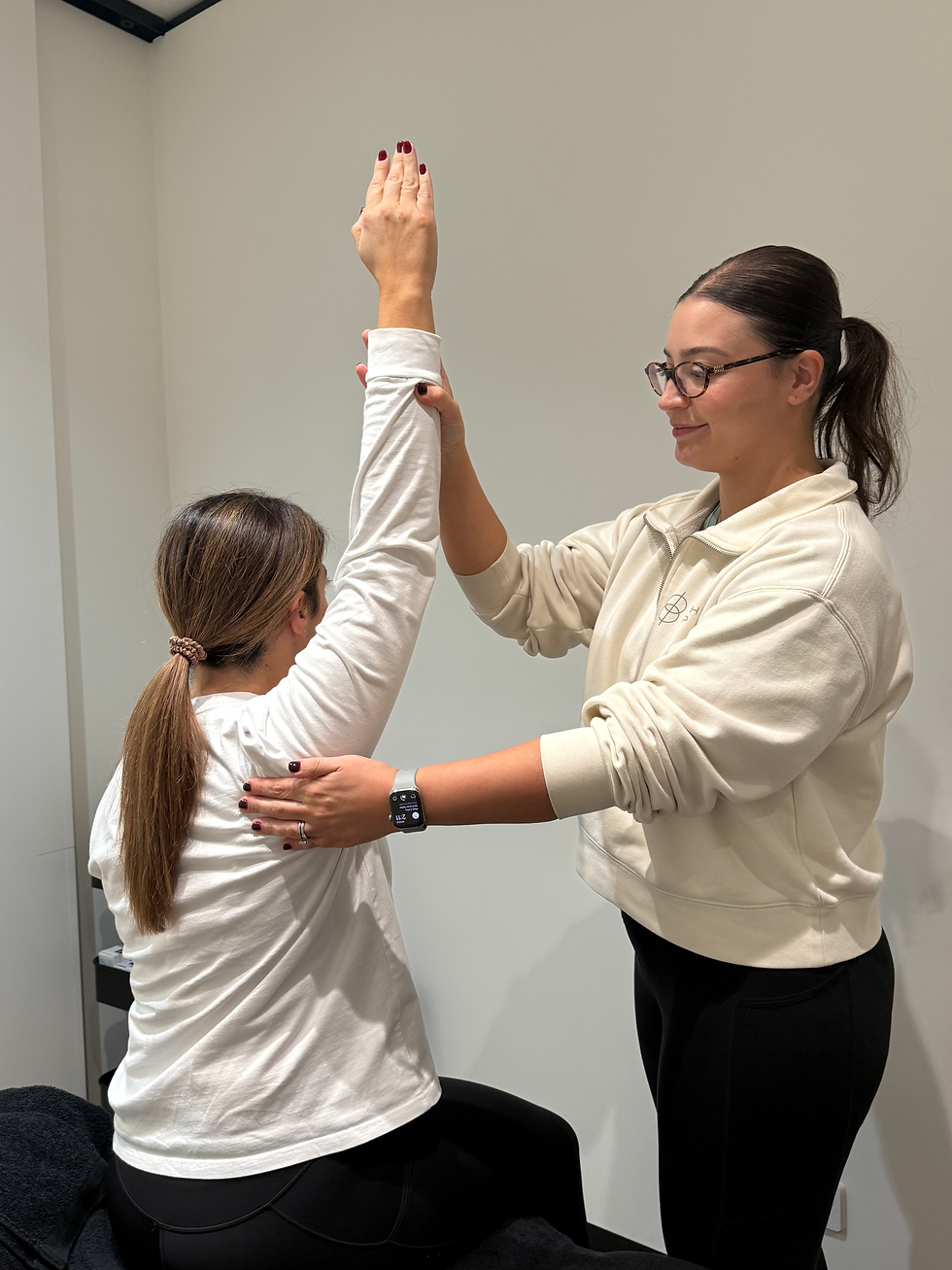
At Colab Health Group, your physiotherapist will conduct a thorough assessment of your shoulder before recommending any treatment. This includes assessing your range of motion, strength, postural habits, movement patterns and the specific structures involved in your pain.
Treatment typically includes a combination of:
Hands-on manual therapy Joint mobilisation, soft tissue release and massage to reduce pain, improve joint mobility and restore normal movement through the shoulder and thoracic spine. For frozen shoulder in particular, early and consistent manual therapy is important for preventing the condition from progressing through its stages unchecked.
Targeted strengthening
Specifically prescribed exercise programme to address the rotator cuff, scapular stabilisers and upper back muscles. This is the single most important long-term intervention for most shoulder conditions. Exercise therapy is the first-line treatment for rotator cuff-related shoulder pain and is recommended in all clinical practice guidelines.
Postural retraining Building on the work discussed in our postural pain post, your physio will address the habitual patterns of muscle tightness and weakness that are loading your shoulder inefficiently and provide practical strategies for your workday and daily life.
Load management and education Understanding what is driving your shoulder pain and what you can safely do (and safely avoid) is an important part of recovery. Your physio will help you modify activities without becoming overly protective of the shoulder since avoiding movement entirely is one of the fastest ways for frozen shoulder to worsen.
Dry needling and taping Useful adjuncts for managing acute pain and muscle tension, particularly in the early stages of treatment when pain is limiting your ability to engage fully with exercise.
What about the hormonal piece?
If you're perimenopausal or post-menopausal and developing shoulder pain or stiffness, it's worth discussing the hormonal aspect with your GP as well as your physiotherapist. Menopausal hormone therapy may help reduce joint pain during perimenopause and menopause research suggests postmenopausal women who received hormone therapy were less likely to develop frozen shoulder compared to those who did not.
Physiotherapy and hormone therapy are not mutually exclusive. In fact, for women with frozen shoulder, the combination of addressing the hormonal environment alongside targeted physical rehabilitation tends to produce the best outcomes. Your physio can work alongside your GP and any other treating practitioners to ensure your care is coordinated.
You don't have to just live with it
Shoulder pain in midlife is common but it is not inevitable, and it is not something you should simply accept. Whether your pain has come on gradually, started after a specific incident, or arrived alongside the other changes of perimenopause, there is almost always something that can be done.
The earlier you come in, the easier it is to treat. Early intervention means less time in pain, a smaller risk of progressing to frozen shoulder, and a faster return to the activities you love.
References:
Lafrance S, Charron M, Dubé MO, et al. The efficacy of exercise therapy for rotator cuff-related shoulder pain according to the FITT principle: a systematic review with meta-analyses. Journal of Orthopaedic & Sports Physical Therapy. 2024;54(8):499–512. https://doi.org/10.2519/jospt.2024.12453
Powell JK. Is exercise therapy the right treatment for rotator cuff-related shoulder pain? Uncertainties, theory, and practice. Musculoskeletal Care. 2024;e1879. https://doi.org/10.1002/msc.1879
Moffatt F, et al. Rotator cuff disorders: An updated survey of current UK physiotherapy practice. Musculoskeletal Care. 2024. https://doi.org/10.1002/msc.1872
Altamimi S, et al. A narrative review of rotator cuff tear management: surgery versus conservative treatment. Cureus. 2024. https://doi.org/10.7759/cureus.77042
Saltzman E, Kennedy J, Ford A, et al. Is hormone replacement therapy associated with reduced risk of adhesive capsulitis in menopausal women? A single centre analysis. Poster presentation, 2023. PMC10392282.
Batterton E. The connection between menopause and shoulder pain. Banner Health. 2024. https://www.bannerhealth.com
Alexander S. Frozen shoulder during menopause. Your Shoulder. 2024. https://your-shoulder.com
Jull G, et al. A randomized controlled trial of exercise and manipulative therapy for cervicogenic headache. Spine. 2002;27(17):1835–1843.
Hinge Health Medical Experts. Frozen shoulder and menopause. Hinge Health. 2024. https://www.hingehealth.com
Medical News Today Editorial Team. Frozen shoulder and menopause: link and how to treat. Medical News Today. Updated December 2025. https://www.medicalnewstoday.com